Mold fit
Confirm external dimensions, thickness, tie-bar clearance, opening requirement, ejection, core motion and loading route.
A fast machine label does not define a productive cell. Start with the part, mold, resin and target output, then test whether injection, plasticizing, cooling, mold motion and automation can work as one stable sequence.
Use the workshop scene as context for the review team, machine access, mold trial, material flow and supporting equipment. It does not prove that the pictured machine is a current high-speed series or that any cycle, output or quality result has been achieved.
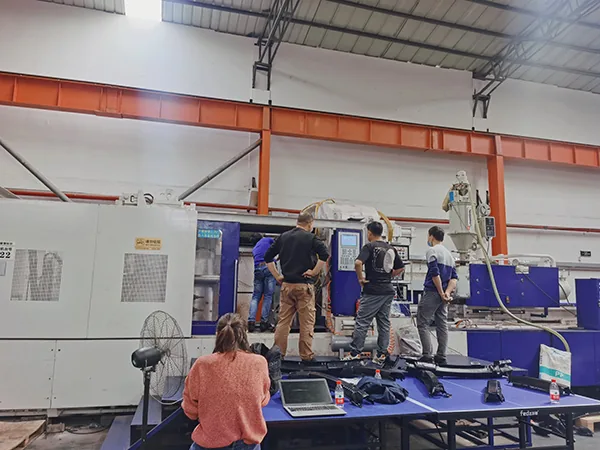
This route is relevant when the commercial case depends on cycle time or hourly output and the mold, material, utilities and automation are ready to be reviewed together. It is not a model availability, clamp-range or performance claim.
Review the application mapCompare each stage against the same target cycle. The purpose is to find the real bottleneck before specifying motion, auxiliaries or automation.
| Cycle stage | Input to collect | Engineering review |
|---|---|---|
| Fill & transfer | Part geometry, flow length, wall sections, resin and process window | Required injection profile, pressure demand and repeatable transfer control |
| Pack & cool | Gate behavior, part quality target, mold cooling and water conditions | Whether cooling or dimensional stability—not machine motion—is setting the cycle |
| Plasticize | Total shot, material grade, color/additives and cycle target | Plasticizing demand, melt quality, residence-time risk and screw suitability |
| Open & eject | Part release, mold stroke, ejector sequence and core motion | The shortest stable motion sequence that still protects the mold and part |
| Take out & handle | Robot path, part orientation, inspection and downstream equipment | Whether automation and handoff can sustain the requested production rhythm |
Each check can change the shortlist. Unknown values should remain open in the quotation instead of being replaced with a generic catalogue assumption.
Confirm external dimensions, thickness, tie-bar clearance, opening requirement, ejection, core motion and loading route.
Review shot volume, material basis, pressure demand, plasticizing rate and screw compatibility as linked checks.
Map filling, packing, cooling, plasticizing, mold motion and handling before assigning time to each stage.
Define mold-water conditions, chiller and mold-temperature control scope instead of treating cooling as external to the machine choice.
Include takeout, insert or label handling, inspection, conveying and rejected-part logic in the cell sequence.
Agree on mold, resin, cavities, utilities, sample duration, quality checks and output measurement before promising a result.
The answers keep the commercial conversation tied to testable project inputs rather than isolated catalogue numbers.
The label or one injection-speed number is not enough. A useful evaluation considers the complete stable cycle: filling, packing, cooling, plasticizing, mold motion, ejection, part takeout and downstream handling under defined part, mold, resin and utility conditions.
No. Part and runner weight inform the injection-unit check, while clamping selection also depends on projected area, cavity pressure assumptions, mold dimensions, opening, ejection and the required safety margin. Both sides of the machine must be reviewed.
Send the part drawing, resin grade, part and runner weight, mold drawing and dimensions, cavity and runner design, current or target cycle, hourly output, utilities, automation scope and destination requirements. Mark estimated values so they are not mistaken for confirmed inputs.
A defensible commitment needs agreed test conditions and evidence. The mold, resin, utilities, auxiliary equipment, quality criteria, number of cavities and measurement period should be defined before cycle or output acceptance is discussed.
Bring the part, mold, resin, current baseline, target output, utilities and automation scope. The worksheet keeps unknowns visible for engineering review.
Build the machine brief